
Our Garage Floor Coating Process in CT
What actually happens from your free estimate to the day you park on your new floor — step by step, with honest cure-time guidance.
Get a Free Quote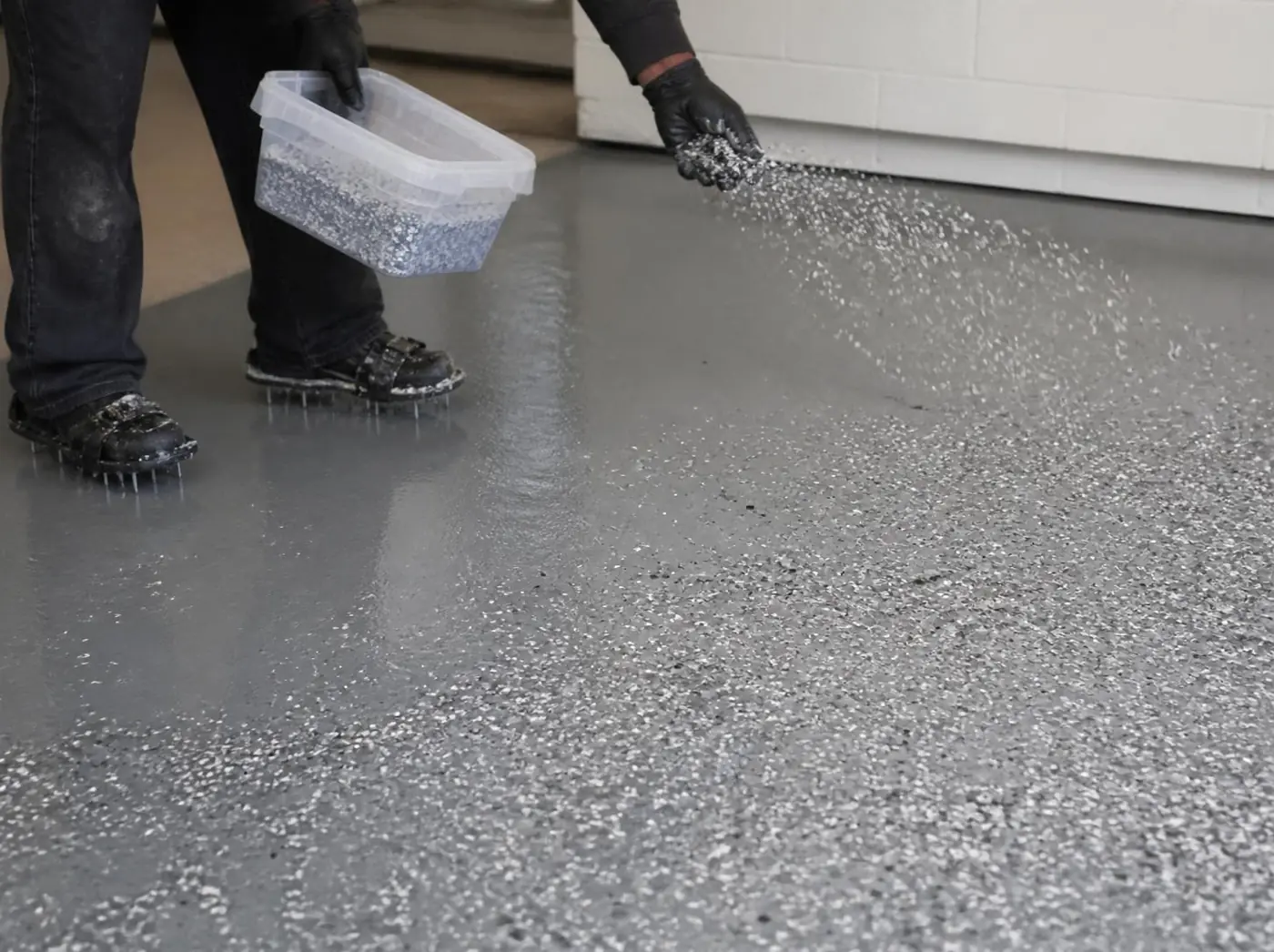
The process at a glance
Every floor is different, but the build follows the same eight steps whether you choose flake epoxy, polyaspartic or metallic epoxy.
- Free estimate and measurement. We visit, measure the floor, look at cracks, pits, old coatings and drainage, and talk through how you use the space. You get a recommended system and a written price.
- Moisture and slab check. We check the slab for moisture and note its temperature. These readings guide which primer and coating we use and when we can install.
- Protect and prepare the space. Once the garage is cleared, we tape and protect walls, doors and the threshold, and set up dust collection.
- Diamond grind and vacuum. The whole slab is ground with diamond tooling to open the surface and remove weak concrete, sealers and contaminants, then vacuumed thoroughly.
- Repairs. Cracks, pits, spalls and salt damage are filled and ground flush. Control joints are filled or left open based on your choice.
- Base coat. A pigmented base coat is rolled out evenly. For metallic floors, this is where the primer and base color go down.
- Flake broadcast. While the base is wet, we broadcast flake to full coverage. Once it sets, loose flake is scraped and vacuumed off.
- Clear topcoat and cure. A clear topcoat seals the floor, with optional anti-slip additive. Then the floor cures before foot traffic and parking.
Below, each step in more detail — what we do, why it matters and what you need to do to get ready.
1. Free estimate and measurement
We start with a visit to your home. We measure the floor, look closely at its condition — cracks, pitting from road salt, oil stains, old paint or coatings — and ask how you use the space. Do you park a daily driver that brings in winter slush? Is it a workshop, a gym or a showroom? Then we recommend a system, show you flake and color samples, and give you a written price. If the slab needs heavy repair, we explain why and what it adds. You can request your free quote here.
2. Moisture and slab check
Moisture coming up through concrete is one of the leading causes of coating failure, so we check before we coat. Depending on the floor, that may be a plastic sheet test, a calcium chloride test or a meter reading. We also note slab temperature, because epoxy generally needs the slab around 50°F or warmer to cure well, while polyaspartic generally tolerates cooler conditions. Learn more in our guide to concrete moisture testing and our article on coating in cold weather.
3. Protect and prepare the space
Before install day, we ask you to clear the floor completely — cars, bikes, shelving on the floor and anything stored against the walls. On the day, we tape and protect the lower walls, doors and the threshold and set up dust collection for grinding. If there are wall-mounted items low on the wall, we will flag them during the estimate.
4. Diamond grind and vacuum
This is the most important step. We grind the entire slab with a diamond grinder connected to a dust collector, which removes the weak top layer of concrete along with sealers, light coatings and surface contamination. The result is an open, consistent surface the coating can grip. Then we vacuum thoroughly. We do not acid etch; see concrete repair and floor prep for why.
5. Repairs
With the slab ground, every crack, pit and spall is easy to see. We clean them out, fill them with a repair material and grind the repairs flush. Salt-pitted areas near the door and under where the car sits often take the most work. Control joints are either filled flush or coated into, depending on what you chose at the estimate.
6. Base coat
We mix and roll out the base coat evenly across the floor, working in sections. For flake floors, the base color is matched to your flake blend. For metallic floors, this stage includes a primer and a tinted base, followed by the metallic coat that creates the pattern.
7. Flake broadcast
While the base coat is still wet, we broadcast flake across the entire floor until it is fully covered — a full broadcast. Once the base sets, we scrape the surface to knock down any high chips and vacuum up the loose flake, leaving a uniform, textured layer ready for sealing.
8. Clear topcoat and cure
A clear topcoat seals the flake and gives the floor its finish and wear resistance. Many systems use a UV-stable polyaspartic topcoat to resist yellowing. If you want more grip for wet winter days, we can add an anti-slip additive. Then the floor needs time to cure.
Cure times: when you can walk and drive
Cure times depend on the product and temperature, so we give you specific guidance for your floor before we start. As general guidance:
- Foot traffic: often about 24 hours after the topcoat, sometimes sooner with polyaspartic.
- Moving items back in: typically after foot traffic is fine, avoiding dragging heavy items.
- Parking with epoxy systems: typically several days, and longer in cooler conditions.
- Parking with polyaspartic systems: typically faster than epoxy, often within a day or two, depending on product and temperature.
Cooler slabs slow curing, and warm weather speeds it up. Most polyaspartic jobs are completed in about a day; epoxy and metallic floors typically take longer. Big repairs or moisture issues can add time.
Ready to start?
Curious about pricing first? Our garage floor epoxy cost guide covers typical ranges, and our FAQ answers common questions. We serve homeowners across Greater Hartford and New Haven, including Manchester, Farmington and Wallingford. When you are ready, request a free quote.
Ready for a garage floor that cleans up in minutes?
Free on-site estimates across Greater Hartford and New Haven County.